
Managing for Bareground With Neighboring Areas in Mind

When you’re maintaining bareground, the goal is a clean appearance with no weeds or vegetation in sight. But what if your bareground location borders an area where vegetation needs to be protected? This article examines five common bareground scenarios and looks at what it takes to achieve clean results — including controlling resistant weeds — without creating risk to nearby trees, crops or waterways.
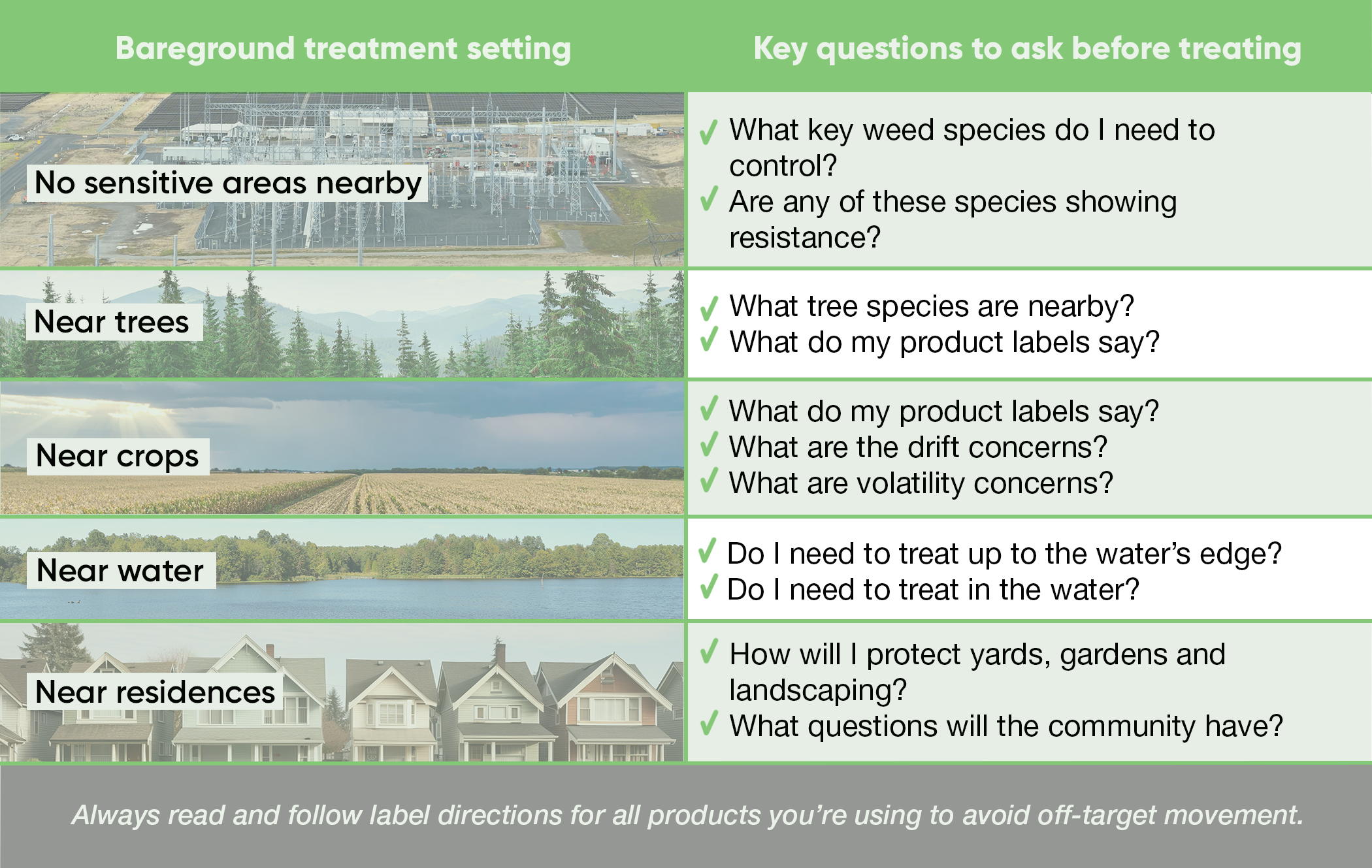
Scenario 1: No sensitive areas nearby
Key question:
What are my major problem species?
Of course, for any bareground job, weed control will be top-of-mind. For locations that do not border any sensitive areas, the task becomes at least a little less complicated. In this scenario, you can focus on the main weed species you need to tackle, including those that may be demonstrating resistance.
Kochia continues to be a major challenge in bareground maintenance. If this is true in your area, look for a product with resistant kochia control. Spike® 80DF herbicide provides proven kochia control and can be combined with HighNoon® herbicide for more modes of action and a wider spectrum of control that covers more than 140 weed species. Piper® EZ herbicide can also be included for a three-way combination that provides residual activity and defense against ALS-resistant weeds. It’s also good practice to add glyphosate to help control emerged weeds at the time of application.
Scenario 2: Near trees
Key questions:
What tree species are nearby?
What do my product labels say?
The first and most important step in this scenario is to identify the species of trees in the area and then check product labels about application near trees. Tree species vary in their herbicide sensitivity. Some herbicides are designed to remove unwanted, invasive trees, but you don’t want to end up damaging nearby ornamentals.
Certain herbicides are labeled for treatment of vegetation under the tree canopy, as long as you avoid foliage contact. Milestone® herbicide can be used for weed control under the canopy of many common types of trees, including maple, oak, ash and poplar species. Other herbicides should not be applied where root uptake is possible. Spike® 80DF herbicide, for example, can be readily absorbed by tree roots. If you’re facing resistant kochia in an area near trees where Spike isn’t an option, consider a postemergent weed control program that includes a product such as Vista® XRT herbicide, which has fewer restrictions around trees. Your Corteva Agriscience vegetation management specialist can also help with recommendations when there are sensitive tree species nearby.
Scenario 3: Near crops
Key questions:
What do my product labels say?
What are the drift concerns?
What are the volatility concerns?
In any vegetation management scenario, it’s good practice to limit herbicide movement toward crops. While some herbicides that work well for bareground, such as HighNoon® herbicide, have excellent selectivity profiles, this doesn’t extend to crops. Unless the product you’re using specifically says it’s safe for a certain crop, assume what you’re applying will cause damage. Think beyond row crops, too. Many herbicides used for bareground will also kill alfalfa, and some can kill desirable grasses.
Pay close attention to drift and volatility notes on labels. Drift and volatility are both causes of off-target movement, but they need to be managed as distinct issues.
Drift happens when spray droplets move through the air, usually due to wind. Drift can also be caused by temperature inversions, which trap and suspend spray particles in a layer of warm air. This often happens when the morning temperature is too close to the overnight low (within 5 degrees). Temperature inversions cause spray particles to drift long distances. Check product labels for any special cautions about temperature inversions. If you suspect you’re experiencing temperature inversion conditions, wait until they clear before treating. Wind speeds greater than 3 mph will typically break inversions.
Drift is best managed by following label recommendations. Follow best practices around wind speed and direction at application and adhere to buffer zone requirements. Always use the nozzles, droplet size and pressure recommendations indicated on the label. Larger droplets are less prone to drift.
Volatility occurs when a spray solution turns into a vapor after application. Volatility is a characteristic of the herbicide formulation or active ingredient. Once the herbicide is in gaseous form, it can then move with the air and settle in a new place. It’s rare, but some row crop herbicides have been known to move as much as half a mile due to volatility. If you’re treating areas near crops, it helps to choose products with low volatility. HighNoon is one option that is essentially nonvolatile.
Be aware that mixing products can also affect their profiles, causing changes in drift or volatility. Carefully follow all label directions on tank mixing, spray drift management and adjuvant selection to avoid these issues.
Scenario 4: Near Water
Key questions:
Do I need to treat up to the water’s edge?
Do I need to treat in the water?
Areas like rocky borders on retention ponds might require bareground management right up to the water’s edge, calling for a herbicide that’s labeled for riparian areas. But if the treatment needs to overlap with the water or be in the water, look for aquatic use labeling. As an example, HighNoon® herbicide can be used up to the water’s edge, while the label for Freelexx® herbicide allows for application in riparian, wetland and aquatic sites. If mixing these two herbicides, use limitations must follow the most restrictive label. In this case, the mixture could not be used past the water’s edge based on the HighNoon label.
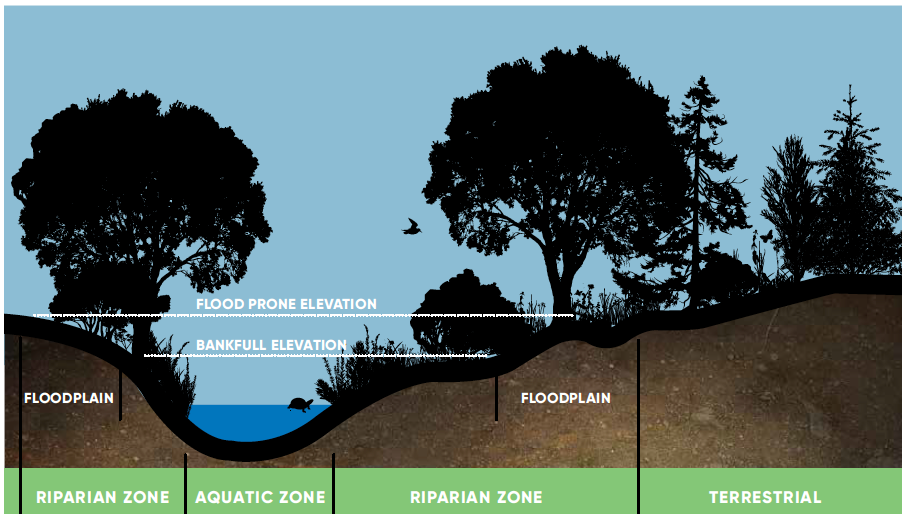
When treating bareground areas near water, check the label to see if the herbicide can be used up to the water’s edge (riparian zone) or has any warning about use in floodplains. Carefully avoid overspray onto the surface of the water unless the herbicide is labeled for aquatic use.
Scenario 5: Near residences
Key questions:
How will I protect yards, gardens and landscaping?
What questions will the community have?
When you’re working near a residential setting, every question already posed above will apply: You may be close to carefully cultivated gardens, trees, ornamentals, lawns and community ponds. Evaluate and select products based on their safety profile for all of these potentially sensitive areas. It’s also important to consider what residents may want to know and what worries they could have. When treating areas like these, a proactive communication approach can help reduce concerns. The Notify Your Neighbor program from Corteva Agrisicence offers free resources and training to help applicators engage in positive conversations about vegetation management.
A Special note about TVC in California
In California, bareground settings are nearly always adjacent to a sensitive area, from groves of high-value tree crops to buried irrigation channels. Cleantraxx® herbicide was developed specifically to meet the needs of California applicators who maintain bareground. It offers two modes of action for broad-spectrum weed control and enhanced resistance management, including for glyphosate-resistant weeds, and provides excellent conifer safety. Cleantraxx also has a favorable environmental and toxicological profile, with a “caution” signal word. Cleantraxx can be tank mixed with any other herbicide, making it easy for applicators to design the right approach for their TVC projects, even when sensitive areas are near.
When it comes to bareground vegetation control, it’s natural to think about weeds first, but concern for bordering areas should come a very close second. Always follow all label recommendations to reduce the possibility of herbicide movement. Careful review of the label for sensitive species, tank-mix partners and application guidelines can help keep your bareground approach on-target for success.
Under normal field conditions, HighNoon® is nonvolatile. HighNoon and Milestone® have no grazing or haying restrictions for any class of livestock, including lactating dairy cows, horses (including lactating mares) and meat animals prior to slaughter. Label precautions apply to forage treated with HighNoon and Milestone and to manure and urine from animals that have consumed treated forage. When treating areas with Cleantraxx®, Freelexx®, Milestone, Spike® 80DF or Vista® XRT in and around roadside or utility rights-of way that are or will be grazed, hayed or planted to forage, important label precautions apply regarding harvesting hay from treated sites, using manure from animals grazing on treated areas or rotating the treated area to sensitive crops. See the product labels for details. State restrictions on the sale and use of Milestone, Spike 80DF and Vista XRT apply. Consult the labels for full details. Not all products are registered for sale or use in all states. Contact your state pesticide regulatory agency to determine if a product is registered for sale or use in your state. Spike® 80DF is a trademark of Nutrichem Company Limited. Always read and follow label directions.
Techline Invasive Plant News
Sharing innovative research, success stories and tips with invasive plant managers.