
Tips to Improve Public Communication About Herbicide Programs

As stewards of rights-of-way that cross private lands and public views, it’s not unusual for vegetation managers and applicators to receive questions about their activities. Sometimes these questions come in planned settings, like public information sessions, but you may also face them on the fly when someone notices spraying, thinning or mowing and wants to know what’s happening.
It can be easy to find yourself caught off guard or even on the defensive when someone questions what you’re doing, especially if they express concern. However, moments like these can also be a great opportunity to help educate the public about integrated vegetation management (IVM), herbicide safety and how the work you’re doing will ultimately benefit the landscape. While you may already be an expert on these topics, how you communicate that expertise can make all the difference in improving public understanding and relationships with communities. Here are some tips to keep in mind.
Make a plan to communicate proactively, not reactively
Reactive communication means addressing IVM questions and concerns only when they come to you. That puts you on defense. By the time a landowner or member of the public stops by to talk, calls the office or sends an email, they may already feel blindsided, confused or upset. That’s not an ideal way to start a conversation.
With a proactive approach, you reach out to landowners and the public first to let them know what’s happening. The best way to do this is by establishing a notification plan that helps you effectively communicate before, during and after a herbicide application. A proactive notification plan can help enhance compliance, reduce complaints and miscommunication, and improve overall program efficiency. It also helps landowners feel like they’re a part of the process and can positively influence public perception of vegetation management and the use of herbicides.
It is important to note that no matter how proactive you are, there are some people with deep-seated opposition to herbicides that you’ll never persuade. Instead, focus your efforts on reinforcing the views of people who already feel comfortable with herbicide use and educating those who are on the fence.
Remember: Landowners and the public aren’t experts in vegetation management
When you work in a technical field like vegetation management every day, it’s easy to forget that not everyone shares your level of knowledge about plants and herbicides. When communicating with landowners and the public, avoid overwhelming them with jargon and data. Instead, share simple facts and information that get right to what your audience cares about. Here are a few examples of plain-language statements you could use to address concerns about herbicide safety:
- The products we use are formulated to only control weeds and brush and then break down after they’re applied.
- Most herbicides we apply are broken down by microbes in the soil, some as quickly as in a few hours.
- The majority of spray material in most herbicide applications is water. Herbicides are usually diluted with water to facilitate better plant coverage. In most cases the solution being sprayed is between 91% and 99% water, or equal to as little as a few ounces per acre.
- Herbicides are registered with the U.S. EPA and our state’s agency. All herbicides sold in the United States must be accepted for registration by the EPA based on a minimum of 120 scientific studies showing that the pesticide will perform the intended function without “unreasonable adverse effects” on humans, animals (such as livestock) or the environment.
Pair expertise with understanding
Conversations about herbicide application can be sensitive, but your approach can make all the difference in creating clarity and comfort. Here are a few techniques to use:
- Speak with confidence and authority. Remember: You’re the expert when it comes to vegetation management.
- Put the landowner at ease. In many cases, you are a new face to them. Help create a comfortable interaction.
- Show empathy. Acknowledge people’s concerns. Let them know you’re human too, and you can relate to their concerns.
- Listen, listen, listen. Give people a chance to voice their concerns and tell you about prior experiences that have influenced their feelings. Give people a chance to vent before you respond.
- Control the discussion. Keep the conversation on track.
- Be honest. If you don’t know an answer, commit to following up within 24 to 48 hours.
- Be polite, even if verbally attacked. This can be difficult, but people tend to calm down more quickly if you don’t overreact to their emotions. Don’t get drawn into an argument. State the reasons why you need to control the vegetation and don’t allow yourself to become angry. If you remain calm and pleasant, it’ll be difficult for the other person to stay angry with you.
- Treat everyone equally. If you’re speaking to more than one person, acknowledge each person’s questions and concerns.
Prepare and practice your message
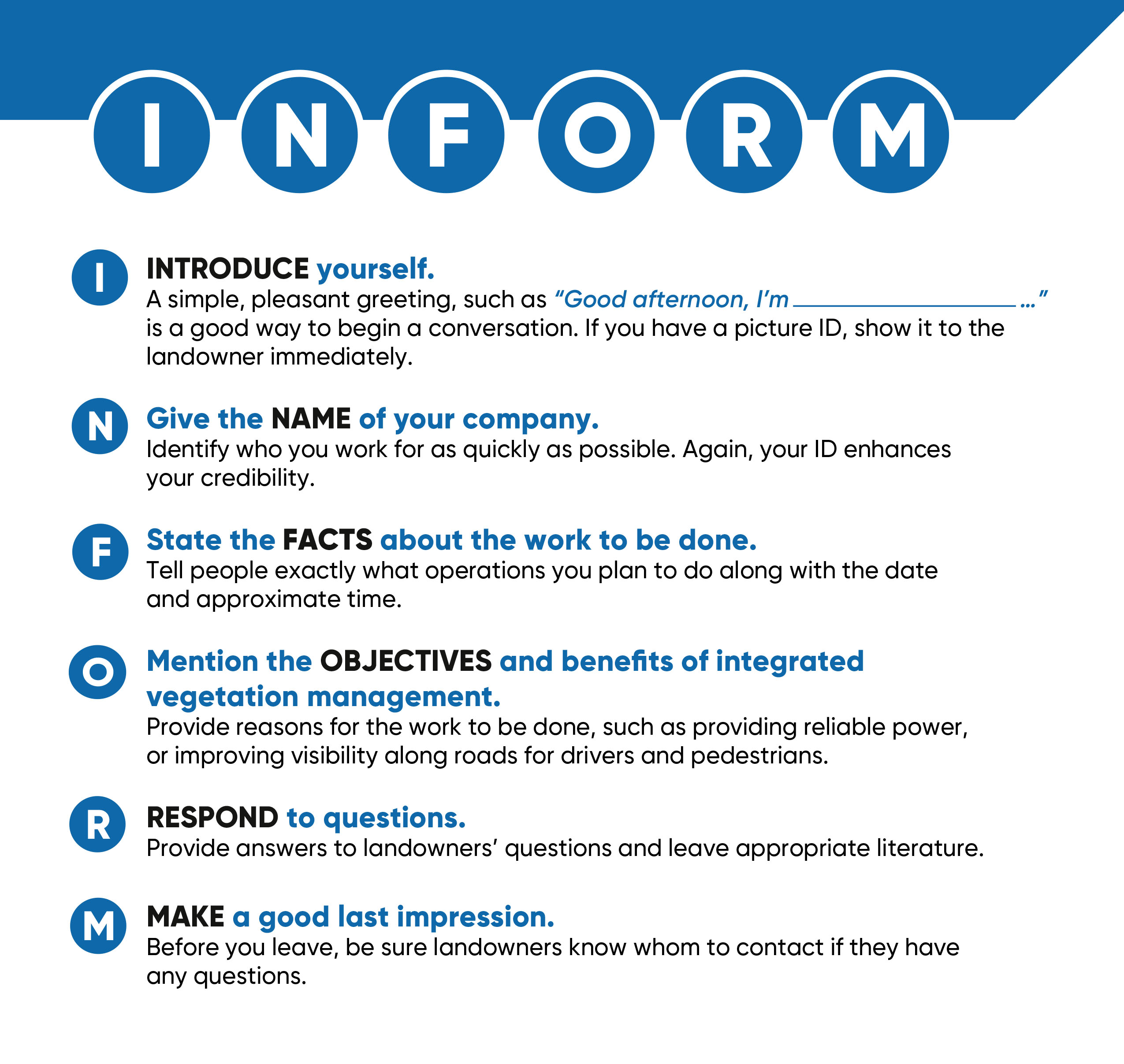
Develop your proactive communication message and, yes, rehearse it! Try using the INFORM model to craft what you want to say.
Know your A-B-Cs
Once you have your message down, prepare for responding to questions or concerns using the A-B-C technique, which stands for acknowledge, bridge and communicate. First, you acknowledge the person’s question and/or concern. Then you use a bridge statement to connect the acknowledgement to the communicate section. The communicate section is where you deliver your key messages. Here’s an example: 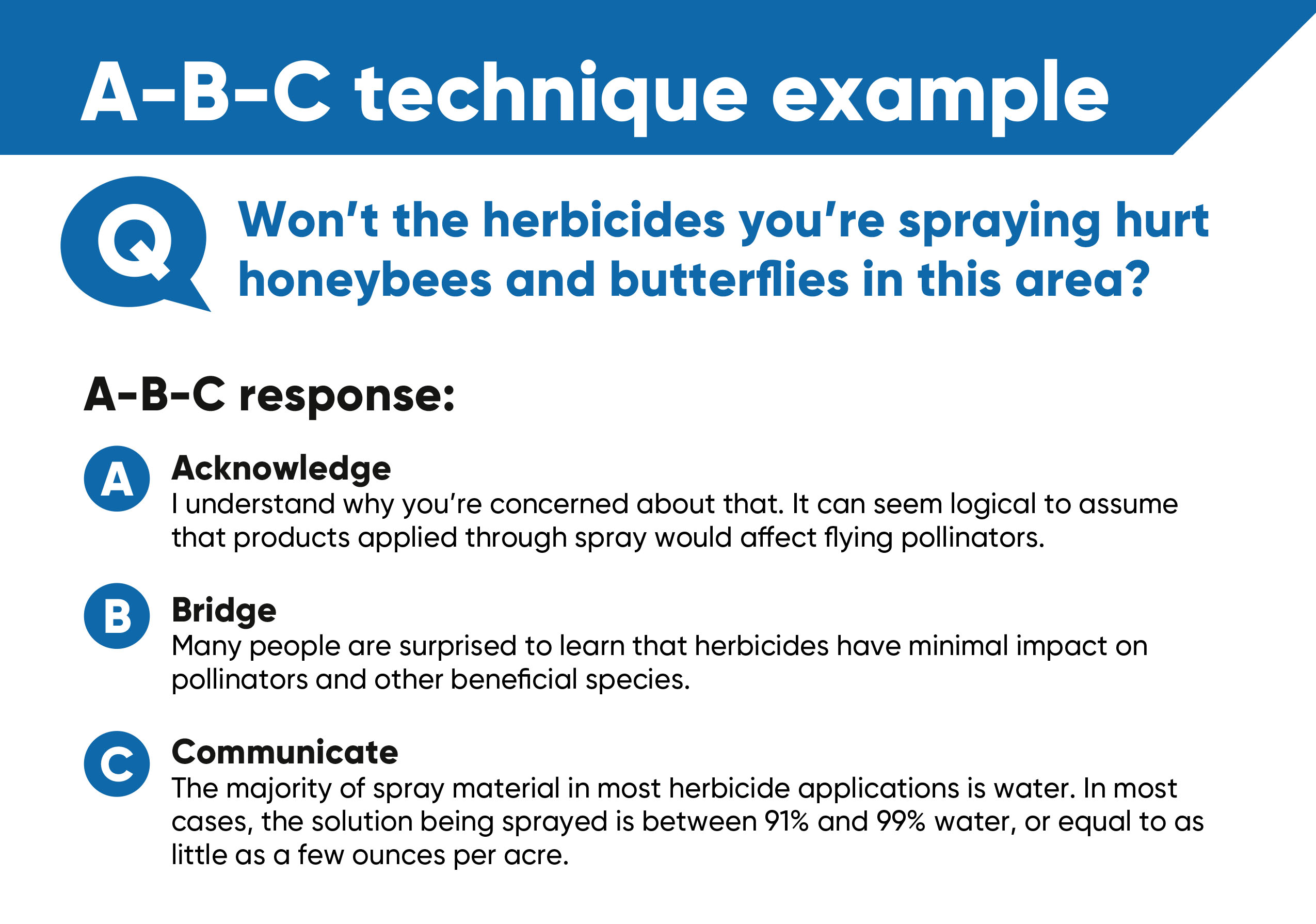
Access in-depth training and resources
In addition to these tips, Corteva Agriscience offers more resources through the Notify Your Neighbor program. Notify Your Neighbor is divided into five modules and includes downloadable resources, such as the “Notify Your Neighbor Resource Guide” and a “Message to Our Neighbors” brochure that can be shared with the public. The program also features a series of videos demonstrating effective — and ineffective — communication techniques through realistic scenarios. These resources are free to use and provide a practical way to strengthen your team’s communication skills and support more positive public interactions.
Techline Invasive Plant News
Sharing innovative research, success stories and tips with invasive plant managers.