
Three-Part Herbicide Mixture Helps Improve Forage and Landscape

For nearly a decade, Ken Matteri was keeping an eye on a growing problem on his ranch. Medusahead rye was taking over more and more forage ground. Ken and his son, Jordan, raise cattle in the southeastern corner of Oregon, where they feed their animals with a combination of hay and grazing.
The Matteris knew they needed a solution that was more comprehensive than ground spraying. The ranchers began leveraging resources available through the Malheur County Soil and Water Conservation District (SWCD). Watershed Technician Gary Faw helped the Matteris get started with some grant requests. He also connected them to the local cooperative weed management area (CWMA) and National Resources Conservation Service (NRCS). It was the start of a fruitful collaboration.
“No single agency can do it all,” Faw said. “Sometimes one agency can get funding to pay for one part of a project, and another agency can pick up another part.”
The NRCS recommended that, first, the Matteris improve water distribution on their land to help their cattle graze a wider area. “They helped us with grants to fund wells and troughs to help our cattle spread out,” Jordan explained.
This led to more discussion about tackling annual grasses. Between grant funding from multiple sources, they would eventually be able to treat a little over half of the Matteris’ acreage.
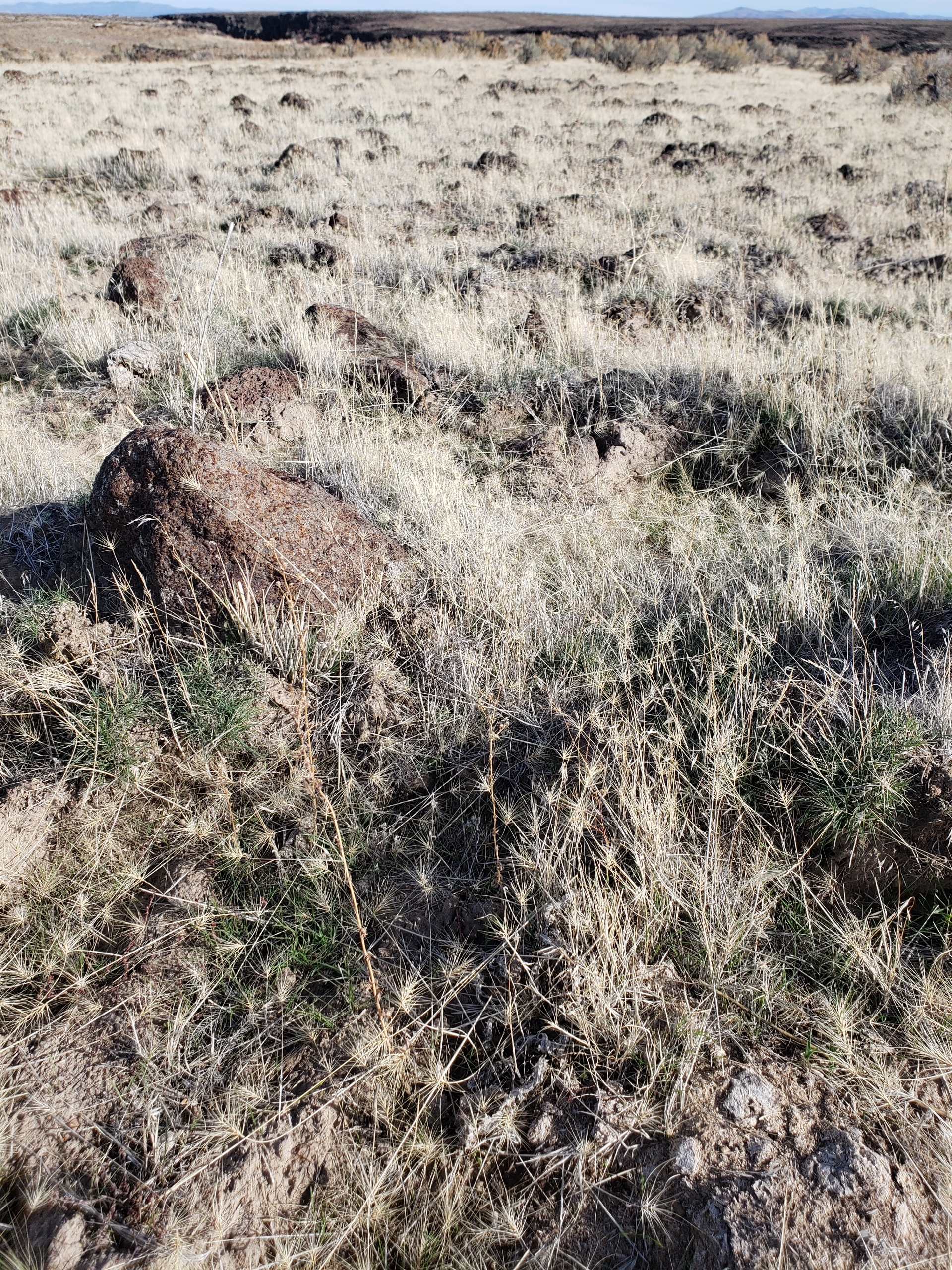
Medusahead grass was taking over valuable grazing area on Matteri & Sons Ranch. Cattle cannot eat the grass once it develops a head, as seen here.
Developing an aerial spray program
Eric Morrison, Jordan Valley CWMA Coordinator, enjoys the opportunity to work with local ranchers like the Matteris. This high desert area is sparsely populated. “We have a gas station, a food truck, a convenience store and a hardware store,” Morrison said. But the people who call this area home are special.
“There’s a strong history of mining and ranching here,” Morrison said, “and the individuals who live down here are top notch. The ranchers here have the attitude: ‘I want to leave it better than I got it.’ They do a lot of work to improve what is there.
“The biggest thing for our CWMA is, it’s landowner driven,” Morrison explained. “We have a lot of trust and relationships that have helped us be successful.”
Faw agreed, emphasizing that the ultimate decisionmaker in these kinds of projects is always the landowner. “We can advise, but the best thing is for them to have options.”
The team secured funding for initial aerial herbicide application of about 1,200 acres in the fall of 2023. After consulting with multiple herbicide suppliers and experts, the Matteris decided to apply a combination of Rejuvra® (indaziflam) and Plateau® (imazapic) herbicides with a focus on controlling medusahead rye. The program worked so well, the Matteris decided to treat another swath of their land the following year. This time, however, they wanted additional weed control.
Adding HighNoon® herbicide to the mix
The Matteris identified 2,000 more acres to treat in the fall of 2024. This area included another problematic species: Scotch thistle. If the next spray controlled only the medusahead rye, it would leave an opening for Scotch thistle to take over. The Matteris began looking for a herbicide they could add to the program to control their thistle problem. Whatever they added would be paid for out of their own pockets, not grant funded, so the Matteris needed a herbicide that would be worth their investment.
Eric Morrison mentioned HighNoon® herbicide as an option. “We’d had a lot of success with Milestone and I knew that HighNoon was a close relative,” Morrison said.
HighNoon combines the active ingredient in Milestone® herbicide (aminopyralid) with Rinskor® active, which enables a broader spectrum of control and improved environmental profile. HighNoon is a selective herbicide designed to help maintain desirable vegetation in range and pasture settings. HighNoon also has no active ingredient tank-mixing restrictions, making it a highly flexible herbicide partner.*
After exploring multiple options, “HighNoon seemed like the biggest bang for our buck since it has residual control,” Ken said. Jordan added, “We figured that with the helicopter there [for application], we might as well add HighNoon because it was the right thing to do for the long run.”
HighNoon seemed like the biggest bang for our buck since it has residual control.
—Ken Matteri, Rancher
The results were apparent right away. “You could definitely see where HighNoon had killed the thistles,” Jordan said, “You could see the line where it was sprayed with the naked eye.”
The control of medusahead rye, and now Scotch thistle, would end up providing another significant benefit for the ranch.
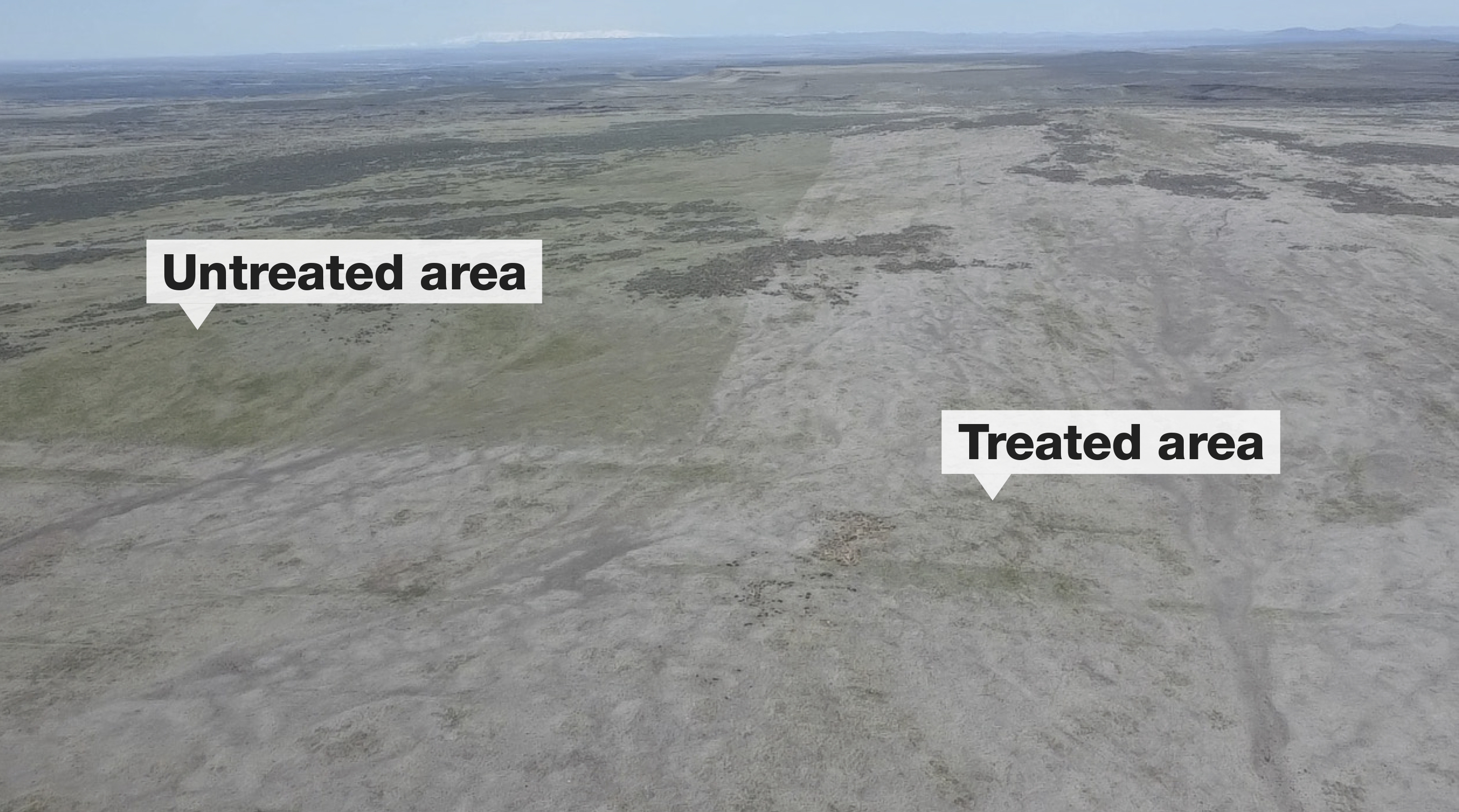
In this 2025 aerial photo of Matteri & Sons Ranch, there is clear delineation of the herbicide treated area and untreated area.
Reducing fuel load
The Jordan Valley region of Oregon is a high desert climate. The landscape is prone to fires, often sparked by lightning. Annual grasses increase fuel load and can make f ires more difficult to control. In the summer of 2025, a nearby fire spread to an area of the Matteri ranch that had not yet been treated in the aerial herbicide program. While the fire itself wasn’t unusual, the way it responded was surprising.
“When the fire came up to the area that had been treated, it did not have the small fuels to carry it further,” Morrison explained. “It basically burned to that treatment line.” The fire was knocked down to a level where it could be more easily controlled. “We saw the fire lay down,” Jordan said.
When the fire came up to the area that had been treated, it did not have the small fuels to carry it further. We saw the fire lay down.”
—Jordan Matteri, Rancher
“Whether you’re eliminating fuels through herbicide treatments or better management of livestock and greater utilization of grasses, you’re getting rid of the fuel the fire needs,” Morrison said. Where the grass has been managed, “That’s where fire crews know they have a good chance of getting ahead of a fire.”
Challenges and considerations in herbicide management
For others looking to implement a similar herbicide approach, Morrison and the Matteris have a few words of advice. For Morrison, moisture conditions are top-of mind with fall treatments.
“We get very little rain here from July to October,” Morrison said. That makes for dusty conditions that can cause herbicide to move off site after application. For this reason, Morrison recommends herbicides with flexible application options. “Nature doesn’t always care what the calendar says,” he added. “It’s good to be able to apply according to the conditions.”
Faw noted that with a cooperative project like this one, communication is critical. “The chemical reps, the CWMA, landowner, NRCS, SWCD — we all needed to have open communications to keep things on track. Everybody’s got to talk to one another,” he said.
For Jordan, patience is key. Grant projects are long-term endeavors. “It took five to six years to get the process going with the grant. But you just have to get started! Start small and then it will really develop into something.” Ken agreed, saying, “It’s all about persistence. You have to stay with it.”
Looking ahead
The Matteris are indeed “staying with it.” In fall of 2025, they completed aerial treatment of another 1,200 acres using the three-product combination of indaziflam, imazapic and HighNoon® herbicide. Annual grass aerial treatment will likely continue for one to two more seasons, but they don’t anticipate the need to re-treat any of the Scotch thistle areas aerially. “We’re happy with the results we saw on the Scotch thistle. You could see skeletons of plants from the previous year and very, very few rosettes,” Morrison noted. From here on, the Scotch thistle should be manageable with ground rig spraying. The Matteris are also working on getting a spray drone up in the air for targeted treatments.
Although it can take years for an area like this to fully recover, perennial vegetation is already making a comeback. “We’re seeing Sandberg bunchgrass, wheat grass and other plants,” Ken said, “The natives are coming back thicker and the ground is absorbing more water. This means better feed for our cattle and better fire resistance.”
In areas left open by the removal of medusahead rye, the family plans to do an aerial seeding, likely in 2026, followed by post-emergent aerial herbicide application to help protect the new growth. The Matteris continue to keep the long view in focus.
“When we seed this, we’ll have to keep the cows off of it. That hurts a little in the short term because we’ll have to pay for more hay,” Jordan said. “But I like leaving something for my kids someday.”
Ken echoed the sentiment. “When you’re in our business you have to look way down the road at the next generation that’s coming up the road, too.”
The success of this project has garnered a lot of interest from the NRCS, Bureau of Land Management and neighboring ranches. “We definitely promote what we did,” Jordan said. Ken added, “The more people who adopt this kind of approach, the better.”
All photos courtesy of Jordan Matteri.
*Always perform a jar test to ensure the compatibility of products to be used in tank mixtures.
Under normal field conditions, HighNoon® is nonvolatile. HighNoon and Milestone® have no grazing or haying restrictions for any class of livestock, including lactating dairy cows, horses (including lactating mares) and meat animals prior to slaughter. Label precautions apply to forage treated with HighNoon and Milestone and to manure and urine from animals that have consumed treated forage. State restrictions on the sale and use of Milestone apply. Consult the label for full details. Not all products are registered for sale or use in all states. Contact your state pesticide regulatory agency to determine if a product is registered for sale or use in your state. Always read and follow label directions. Plateau® is a registered trademark of BASF. Rejuvra® is a registered trademark owned by Environmental Science U.S., LLC or one of its affiliates.
Techline Invasive Plant News
Sharing innovative research, success stories and tips with invasive plant managers.