
Trends in Drone Application for Vegetation Management

Across the U.S., drone technology is taking off in agriculture — literally and figuratively. In 2021, the Federal Aviation Administration (FAA) issued 40 waivers to make drone spray applications. By the end of 2025, there were at least 1,700.
Ranchers, land managers and row crop farmers have become quick adopters because drones offer so much utility. Piloted from a safe distance, drones can reach rugged terrain beyond the reach of four-wheelers. And precision GPS, LiDAR and 3D terrain mapping enable incredibly accurate applications that account for factors like physical obstacles, avoiding sensitive areas and treating based on weed density.
As quickly as drone use is expanding, so are the capabilities of the technology. Whether you’ve already used drones on your operation for several seasons or you’re just starting to consider how they fit into your weed control program, we’ve identified three areas to be aware of that are shaping current trends in agricultural drone applications.
Hardware trends
First, machines are getting bigger, with more tank capacity, able to carry bigger payloads. Improved batteries mean machines are more dependable and can cover more acres each day. Auburn University Extension Professor Steve Li, PhD, says that applicators can spray nearly any type of pesticide, herbicide, fertilizer and more — as long as it has an aerial label and feasible use rate for drones. As drone technology evolves, ranchers and land managers can use them for more than just spray applications. Granular herbicides, native plant seeds, lime or fertilizers, even a product like fire ant bait have been applied using drones.
But perhaps the biggest advancement in drone hardware is the increasing precision of the spray itself. Travis Bui, PhD, is a regulatory science human safety expert at Corteva Agriscience who works on drone-related issues. “Many drones today have rotary atomizer technology, which lets you change the droplet size on the fly,” Bui explains. “So, if a land manager says, ‘Hey, the weather conditions are changing,’ we can adjust the droplet size to match the label guidance without changing nozzles.” Droplet size is determined by the controller and automatically adjusts with a drone’s speed to ensure even dispersal.
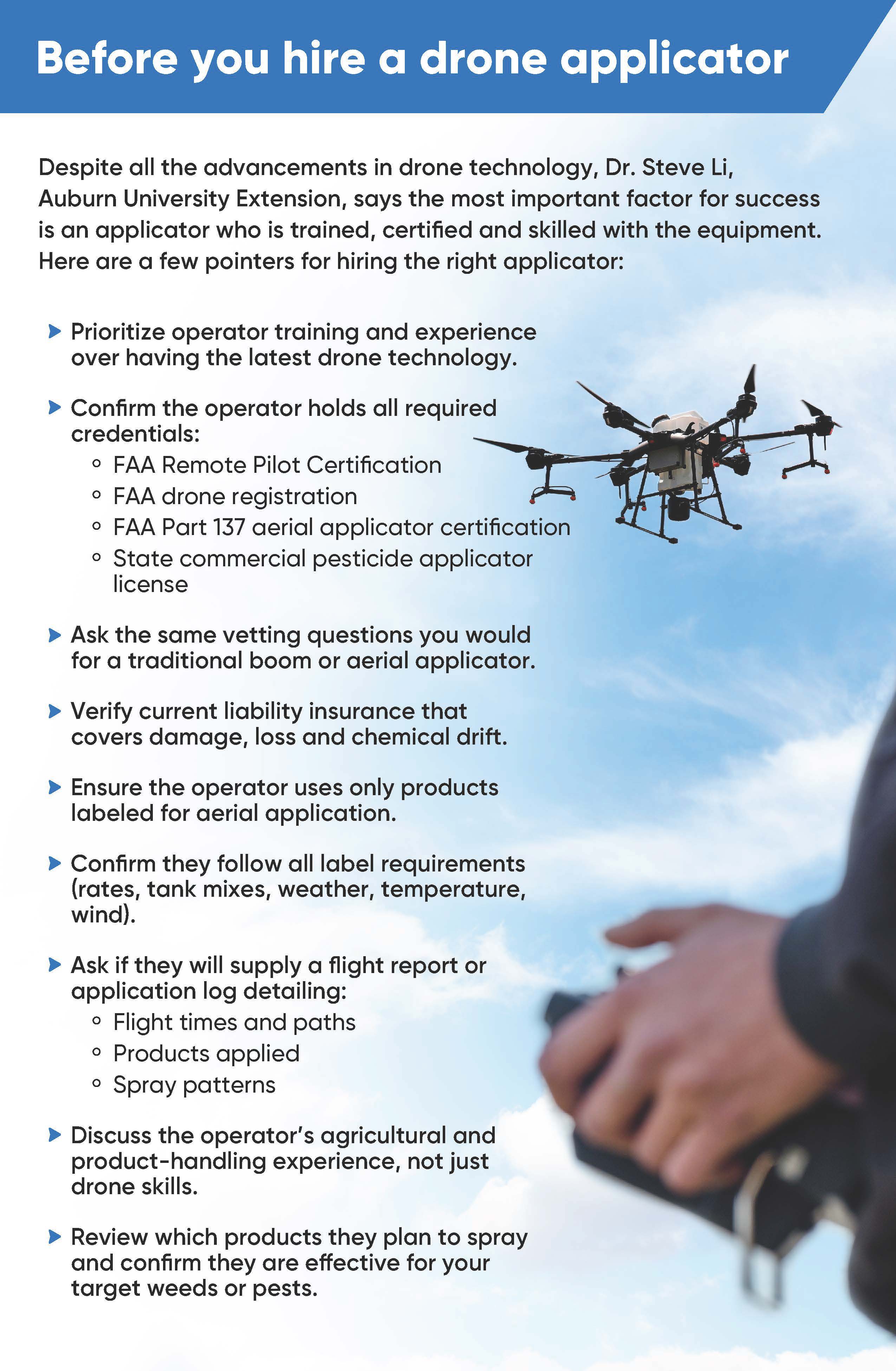
For more information on working with a drone application vendor, check out this TechLine article.
Software trends
Artificial intelligence (AI) is helping advance drone technologies for mapping and application precision. Mapping software in non-spray drones can help identify specific areas with pest and weed pressures before you even get out onto a patch of land. This can help an applicator target where — and where not — to spray. This helps in avoiding endangered species, desirable trees and vegetation, waterways and other sensitive areas.
Another way software is improving treatments is by monitoring product and battery levels on the drone itself, telling it when to return to base. “When a drone is spraying and it runs low, it marks that spot, comes back for a battery change and a refill, then picks back up right where it left off,” Bui says. “With this technology, you won’t have overspray.”
As he looks to the future of drone software and hardware, Li believes more automation is coming. “An autonomous vehicle is the ultimate solution,” Li says. Picture a system where a drone that’s running low flies right on top of an autonomous vehicle that automatically recharges the battery and refills the tank. “The autonomous vehicle could even manage and mix the chemicals and water by itself,” he adds, reducing time and applicator labor.
Regulatory trends
In the U.S., the Environmental Protection Agency (EPA) currently allows the spraying of products via drone if aerial application is listed on the product label. There is currently no drone-specific labeling. In order to get to that point, Bui says the EPA needs to further assess the implications to drone-specific applications.
Corteva and others in the spray drone industry are working to add to the body of data the EPA will need. In addition to his role at Corteva, Bui is also chair of the Unmanned Aerial Pesticide Application System Task Force (UAPASTF), a five-year-old organization founded to generate information and data to support pesticide exposure and risk assessments for drone-based applications by regulatory agencies around the world.
Bui says he is frequently asked when drone application guidelines are going to be placed on product labels. “We are working hard on generating regulatory data to move the needle on labeling,” he says. “We want to make sure that we do it right.” Corteva and other members of the UAPASTF seek a level playing field, where drone applicators undergo the same review process as everybody else, such as ground rig, boom and helicopter and plane operators.
Corteva is playing a role in assessing drone performance and developing recommendations. “As a company, we have to make sure that we’re prepared, that we test our products at drone-specific rates through a drone-specific system,” Bui says. “We want to make sure product labels fit the needs of the community that’s going to be using the products.”
One thing the agricultural spray drone experts can agree on is this: The world of agricultural drones will continue to grow and change — rapidly. “Drones are one piece of an overall precision agriculture landscape that’s continually evolving,” Li says. With “see and spray” technology, weed pressure mapping and other predictive technologies, drones can make more targeted applications and reduce costs for ranchers and other land managers. But as good as the hardware and software are, Li emphasizes the human factor. “I think the key is the person running the drone, running the operation, whether he or she has enough knowledge, enough training when they operate the mission,” he says, “because it’s mostly the people making the difference.”
And when it comes to the people that make up the community of drone operators, Li says it’s important for them to connect and network. And he would know — he’s the founder of the Spray Drone End User Conference (SDEUC), the largest and most comprehensive agricultural drone event in the Western Hemisphere. Its growing attendance year-over-year mirrors the growth of the industry. SDEUC gives drone owners and operators and other agricultural professionals a chance to ask questions, learn about new technologies and network with people working in the field. The 5th conference will be held in May 2027 in Savannah, Georgia. See SDEUC.com for details; the website will be updated in June 2026.
Techline Invasive Plant News
Sharing innovative research, success stories and tips with invasive plant managers.